Our work

Everything we install, and what each one is actually for.

No two Austin yards need the same system. Clay and caliche drain nothing like a Hill Country slope. Here's what each option actually does, so you can talk to us with a clear picture.

Get My Ballpark Estimate
01

French Drains

Central Texas soil is clay over caliche, so water sits on top instead of soaking in. We dig along the trouble line, line the trench with filter fabric, set a perforated pipe in washed gravel, and slope it to an outlet that gets the water out of your yard. It leaves before it reaches your foundation.
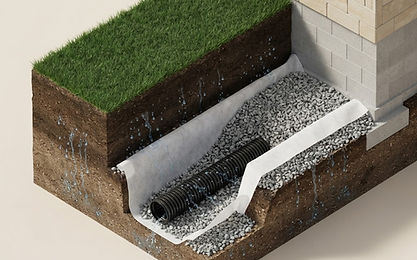
3D cutaway rendering showing how a french drains system is built

Usually includes

  • Filter fabric and washed gravel
  • Perforated pipe with a cleanout
  • Discharges above ground or into a basin
  • Sod or seed restoration
02

Catch Basins & Dry Wells

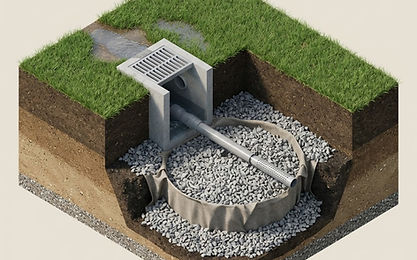
Set at the low spot of the yard or at the end of a buried line, a basin catches surface water and sends it into a drain line or a limestone-filled dry well where it soaks away. On a lot with a hard clay pan, this is often the difference between a puddle and a usable lawn.

3D cutaway rendering showing how a catch basins & dry wells system is built

Usually includes

  • Concrete or poly basin with grate
  • Buried discharge line or dry well
  • Stone reservoir
  • Grading around the rim
03

Surface Drainage & Grading

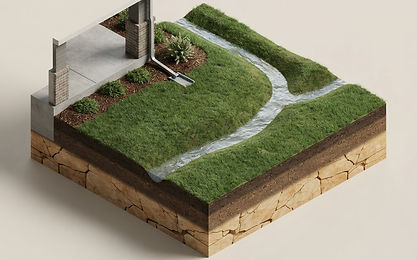
Many Austin lots have only inches of topsoil over a limestone shelf, so surface water has to be graded rather than absorbed. Swales, berms and regrading give it somewhere to go. It's usually the least expensive fix, and it's often paired with a drain line for the worst spots.

3D cutaway rendering showing how a surface drainage & grading system is built

Usually includes

  • Swales and shallow berms
  • Regrading away from the slab
  • Positive fall to a safe outlet
  • Topsoil and native seed
04

Downspout Extensions

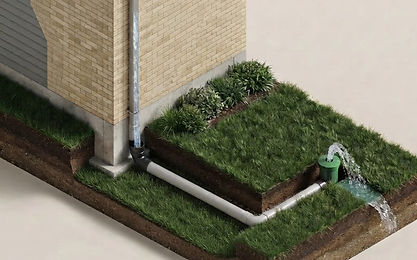
A single Austin storm can put more water off your roof than the whole yard can hold. We tie the downspouts into solid pipe, bury it below grade and discharge it far enough out that roof water never lands next to the foundation. Pop-up emitters keep it discreet.

3D cutaway rendering showing how a downspout extensions system is built

Usually includes

  • Solid PVC or flexible pipe
  • Downspout adapters and boots
  • Pop-up emitters
  • Trench and turf repair
05

Dry Creek Beds

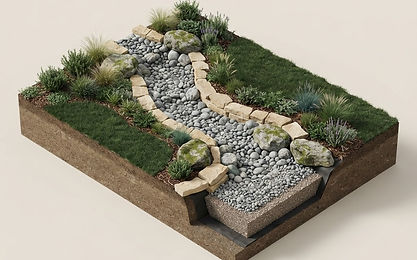
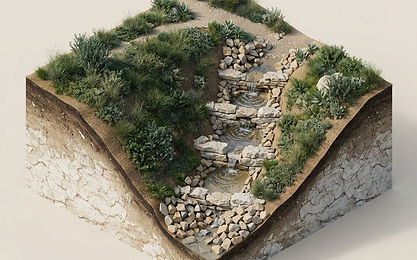
Native limestone and river rock over filter fabric create a channel that handles heavy flow and reads as part of the landscape instead of a utility. It's the go-to choice where the grade won't let a buried line reach a proper outlet.

3D cutaway rendering showing how a dry creek beds system is built

Usually includes

  • Filter fabric and limestone rock
  • A channel sized with a gentle slope
  • Boulder accents
  • Native planting pockets on the banks
06

Erosion Control

Thin topsoil over caliche means a slope can cut a gully in one storm. We slow the water where it actually runs with check dams and rock, then plant natives to lock the soil in for good.

3D cutaway rendering showing how a erosion control system is built

Usually includes

  • Slope stabilization
  • Check dams and rock
  • Erosion blanket where needed
  • Native grass and groundcover

Not sure which one you need?

That's what the estimate tool is for. Describe what you're seeing and we'll suggest the combination we'd start with. Rough measurements are fine. We confirm everything on the walkthrough.

Start my estimate
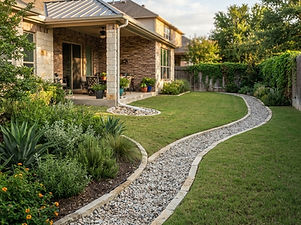
A residential French drain gravel trench running along a backyard lawn